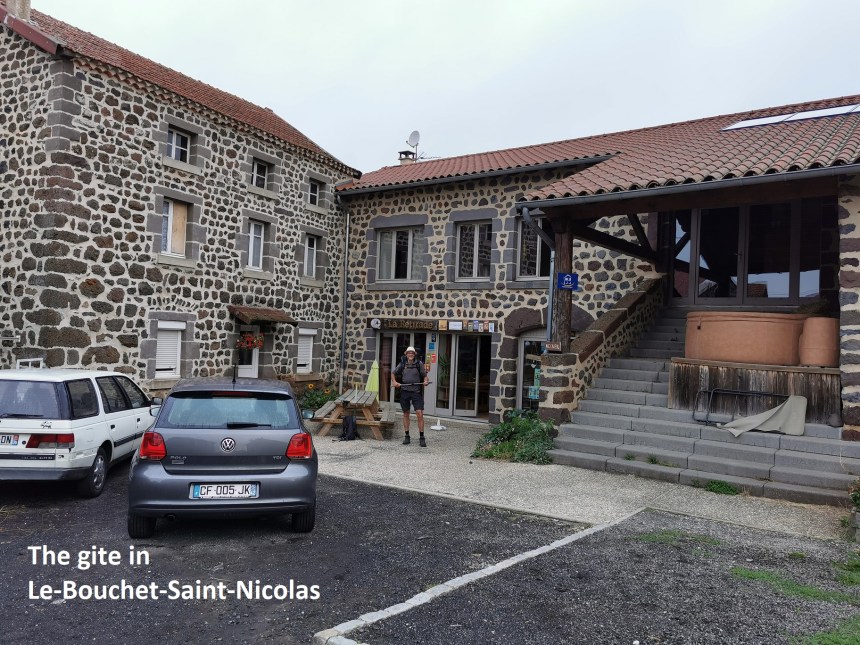
Stevenson mentions having to share his room at the inn in le Bouchet-St-Nicolas with a French couple. His Victorian attitudes come to the fore. He mentions being abashed at the experience and keeping his eyes to himself to avoid looking at the woman. In the modern world of gites the accommodation is in dormitories, and there is no separation, but decorum rules. Stevenson also mentions rising early before the French couple to avoid any potentially embarrassing encounter with the woman. I rose early after a good night’s sleep, and was first to the bathroom, not for the reasons Stevenson mentions, but to avoid the rush when everyone else in the dormitory got up. Even though Joff and I were early risers from our dormitory, there were others in the dining room before us. We helped ourselves to the food and soon we were ready to continue our walk.
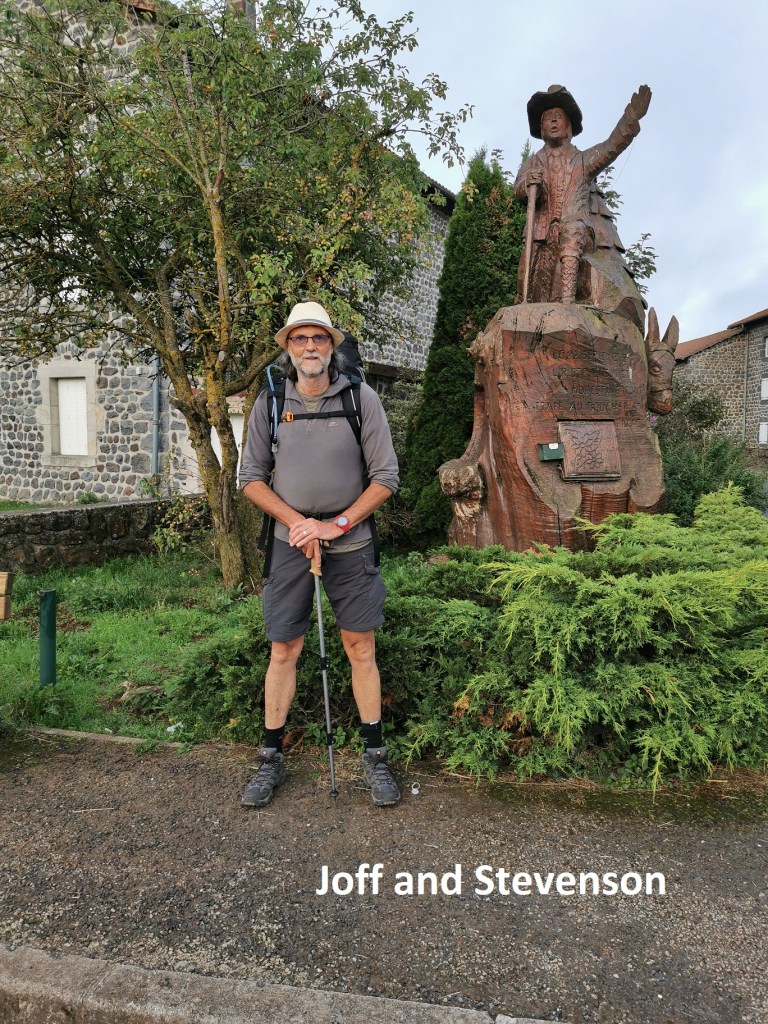
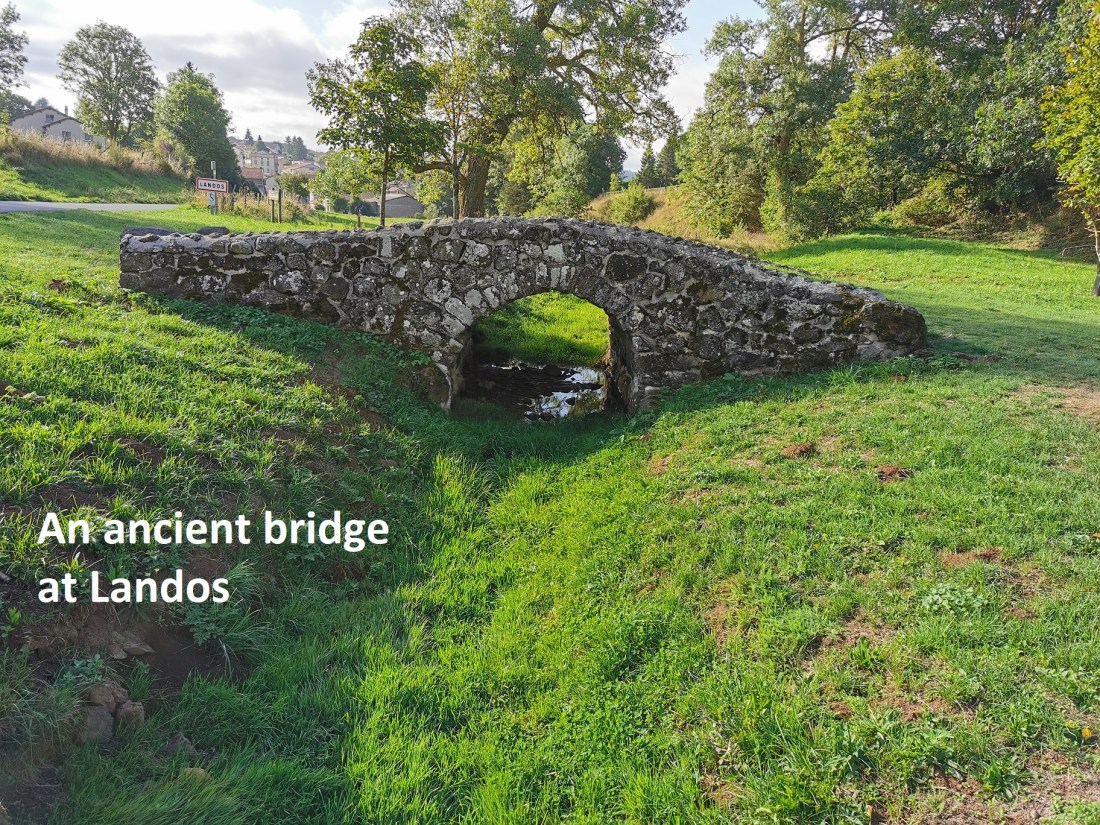
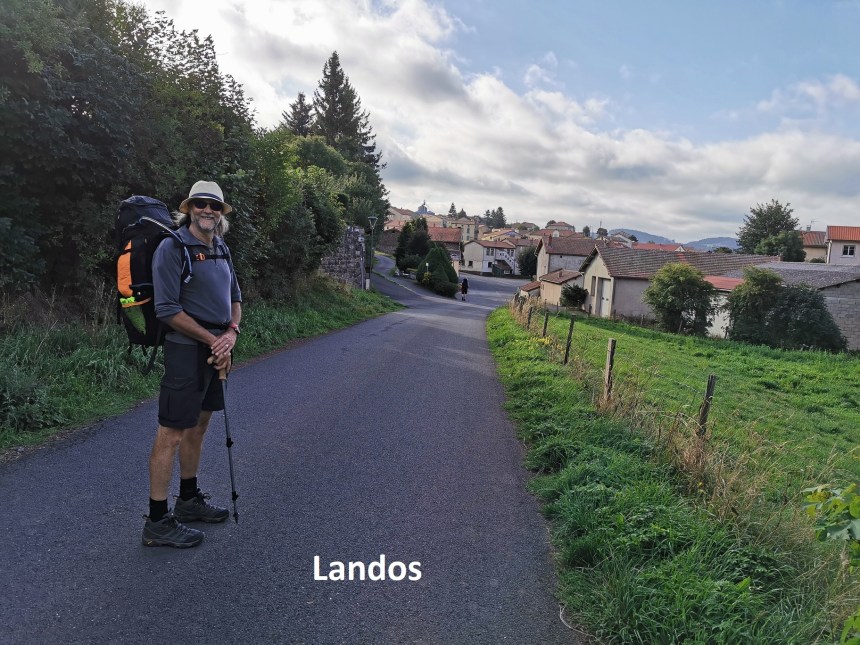
The gite is a little off the route of the trail, so we walked through the village to where the route goes along the main street. At the end of the village, the trail turns away from the street, and just at the corner is a statue of Stevenson as if he were standing on a mound, greeting the world, while his donkey peers out from behind. Stevenson himself has become an iconic presence on the route. The countryside south of Le Bouchet-St-Nicolas is quite flat, and we found it easy going. I am not sure if this lulled us into a false sense of security, but as we chatted along the way, we went off the route, missing a turn. Hoverer, before we had gone very far, a farmer coming the other way redirected us back onto the correct path. We were resolved to be more attentive to the markers and direction indicators, and followed the correct trail from there. We skirted around the edge of les Amargiers and were soon in Landos.
There were other walkers who had arrived not long before us, and all seemed to make for the café in the centre of the village, so we followed suit, on this occasion, it was too early for a beer. The walk from Le Bouchet had not been so energetic, and the hour was too early, so we both had a cup of coffee as we took a brief pause on our journey.
The trail remained almost flat as we went on through fields and woodlands. The sky darkened and it seemed as if it would rain, but the weather gods were on our side, and the rain held off. We reached Jagonas without having to take out the raingear. There is nothing in Jagonas, and the trail does not go into the centre of the village, so we kept on going. It might have been nice to stop in Arquejol, and indeed there were picnic tables in that village to tempt the walker to stop, but there was nowhere to buy food or drink. We continued on.
After Arquejol the trail goes down into a hollow close to a railway viaduct. The trail does not go under the viaduct, but instead ascends the slopes on the other side of the hollow to eventually come level with the railway. The railway, once called the Transcevenole Railway, had a difficult history. The project was first proposed in 1853 on the basis of a line to join Paris with Nimes via Clermont Ferrand. However, no work started on the project until 1857. The first phase of the project was to link Le-Puy-en-Velay with Langogne., and that took in the viaduct and the track through Arquejol. The project seemed to languish after that, but was revived in 1905, with work starting again in 1911. Further work was interrupted by the First World War. After that war, contradicting voices alternatively promoted the line or dismissed it as unnecessary. The French national railway company, SNCF, was created in 1937, and they decided not to go ahead, with completion of the line being formally abandoned in 1941. The completed section of the line is 89km long with twelve viaducts and thirty five tunnels.
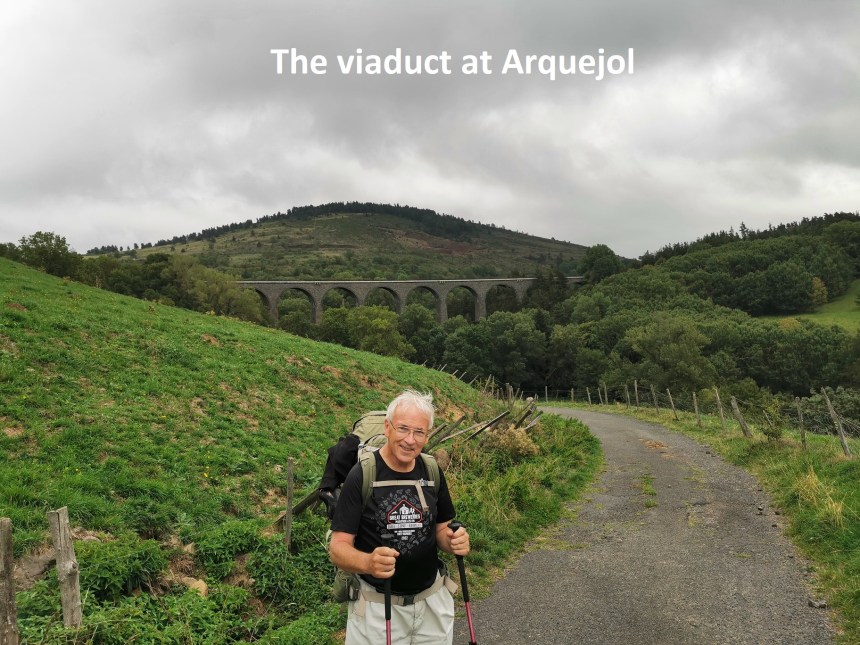
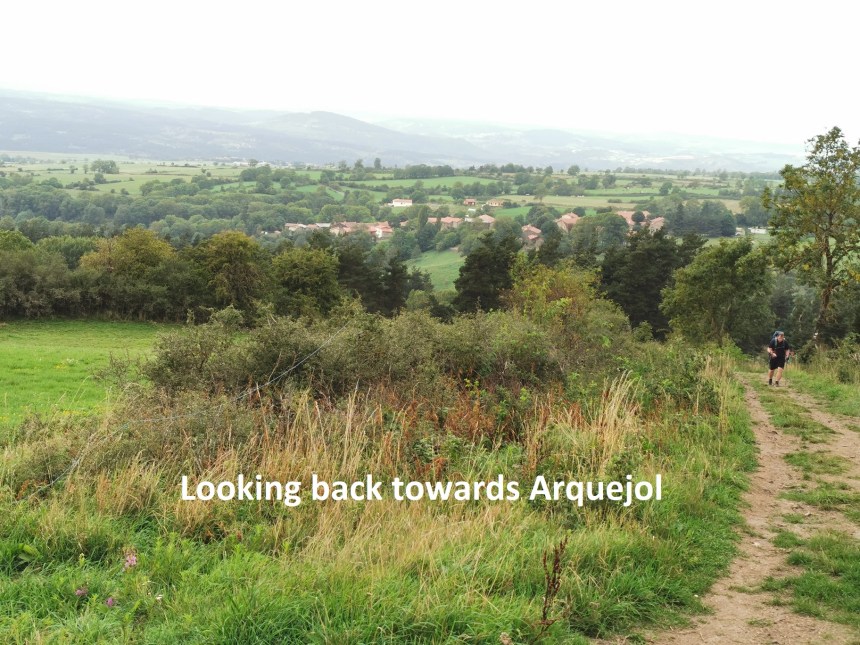
When we came level with the railway, we could see that the sleepers were old and in poor condition, They were not rotten, but simply very old. This section of the line has carried no rail traffic since 1981. But the rails looked as if there had been some recent light traffic. The tops of the rails were shiny as if metal wheeled vehicles had run there recently. Enquiries on the internet showed that there is a company running a vélorail on the track from Pradelles to Arquejol. The vélorail is a light pedalled vehicle using human power to move. It is possible to hire a vélorail in Pradelles, the next stop on our route, and to travel up the line to Arquejol. The clean metal on the rails is the result of cyclists using the vélorail.

After leaving the railway shortly after the viaduct, our trail went up into the hills again. It was eight kilometres of open hillside and forest, and at times seemed to just go on forever. But nothing goes on forever, and eventually we could see Pradelles in the distance. After reaching the highest point of this section at 1265m, it was a steady descent to Pradelles. The grey skies of early in the day had eased, and while it was not exactly sunny, it was a pleasant day when we arrived in Pradelles. We left the trail to join the main road into the town, and soon came to a hotel with the lunch service still available. Both of us were hungry and thirsty and were glad to avail of the fine menu that was on offer. As we ate our way through bowls of tagliatelle, the rest of the clientele finished up and we became the only diners there. The young waitress engaged us in conversation, starting with that standard question of where we were from. As we talked, it turned out that she was not from Pradelles, but somewhere quite distant, though the name of her home town meant nothing to us as foreigners in her land. She did not seem very happy with her lot. The traveling to and from work was difficult, and it seemed that she was frustrated in that she wanted to be doing something else. But such is life. We left her and went to look for out gites for the evening.
The gite did not open until three o’clock, leaving us a short time to wait. We sat in the town square and watched the world go by for a while. The main road through the town is a busy one, with heavy trucks rumbling through every few minutes.
Pradelles is an old town. It was a stopping point on the Path of Saint Gilles, a pilgrimage route that dates back to the ninth century, and at one time was considered the fourth most important in Christendom, after Jerusalem, Rome, and Santiago. The route runs from Le-Puy-en-Velay to Saint Gilles du Gard, southwest of Nimes. The town had a hospital for pilgrims, and in 1512, a small statue of the Virgin was discovered buried in a field near the hospital. No one could explain where the statue had come from, and its discovery was considered miraculous. The status of the little statue became even more elevated when in 1586, a fire ravaged parts of the town, but the church was spared, which was ascribed to the intervention of the Virgin. In the religious wars that blighted sixteenth century Europe, a Protestant Hugenot army approached Pradelles, but was repulsed, an event which was also ascribed to the intervention of the Virgin. In 1793, with revolutionary fervour gripping France, the statue was thrown into a fire, but only suffered minor damage, another event also seen by the townsfolk as miraculous. Although there are no stories of her performing major miracles since then, the statue is paraded around the town on 15th August every year.
Stevenson only stayed less than an hour in Pradelles, just long enough to have lunch and then be on his way again. This was despite the recommendations of the landlady in the inn that he should visit the statue of Notre Dame de Pradelles. If it was not important enough for Stevenson, then it was not important enough for us either, so we did not visit the chapel to see the statue.
When three o’clock came, we made our way to the gite. The place was still locked, but I was able to phone the proprietor and gain access to the key. Another walker joined us. A lady. She was concerned about her walking companion, an Englishwoman. Since she had poor phone reception, I lent her my phone to make contact. Later she was able to use the wi-fi in the gite, and her companion eventually arrived as evening approached.
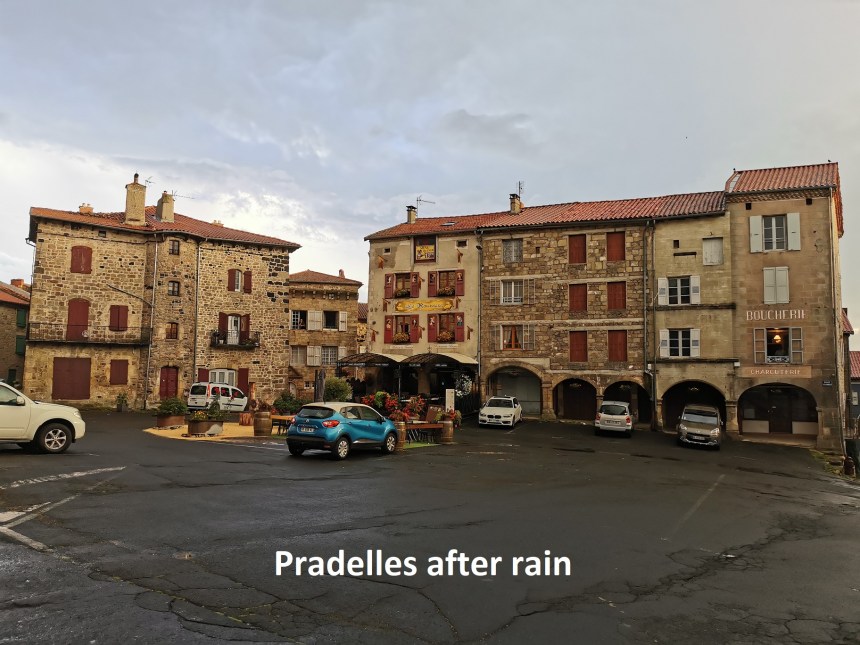
We showered and rested for what remained of the afternoon. The rain that had been threatening in the morning came in during the late afternoon. It was a short but violent thunderstorm, forcing us to remain indoors for a while. As evening arrived, we were again peckish and decided to find something to eat. Unfortunately, a brasserie close by was closing for the evening when we got there, so we were forced to look elsewhere. The other restaurants in the old part of the town were also closed. We had no choice but to go back to the same hotel where we had lunch. It was busier now, with the same waitress rushing to keep the customers served, and with no time to talk to us. The menu was the same as at lunchtime, but there was sufficient choice that we could each eat something different. By the time we were finished, both of us were more than satisfied.
“That’s two full dinners in one day,” remarked Joff. “I was expecting to lose weight on this trip, but at this rate, I will be putting it on, in spite of the distance walked.”
I advised him not to worry, that not every day would be like this. And so, with bellies full, we made our way back to the gite and a good night’s sleep.


